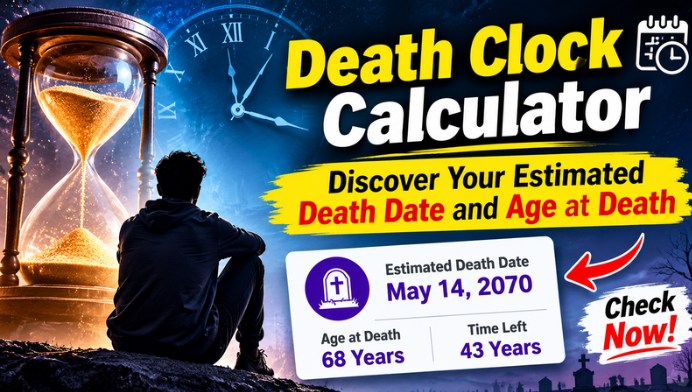
What Is a Death Clock Calculator?
A Death Clock Calculator is a digital calculator that uses information such as date of birth, age, gender and lifestyle habits to generate an estimated lifespan. Depending on the website, it may also consider factors such as physical activity, smoking, alcohol consumption and general health habits. The result is usually displayed as a predicted date of death along with an estimated age at death. However, it is important to understand that this is only a mathematical estimate, not a scientifically reliable prediction of an individual’s actual death.
How Does the Death Date Calculator Work?
Most online death date calculators work by collecting a few basic details from users and comparing them with general life expectancy assumptions. After entering the required information, the calculator applies its estimation method to generate a possible lifespan. Some tools use simple age-based calculations, while others include lifestyle-related questions to adjust the result. The final estimated death date is then displayed automatically. Different websites may produce completely different results because they use different formulas and assumptions.
How to Calculate Your Estimated Death Date Online
Using an online Death Clock Calculator is generally simple and does not require advanced technical knowledge. Users usually need to enter their date of birth and select the requested personal or lifestyle information. After submitting the details, the calculator processes the information and displays an estimated death date and expected age at death. Some websites also provide a live countdown that updates automatically. Users should avoid sharing sensitive personal information with unknown websites.
Check Your Estimated Age at Death
One interesting feature of a Death Clock Calculator is its estimated age-at-death result. Instead of displaying only a future date, the tool may show the approximate age a person could reach based on its calculation method. This result can be interesting to explore, but it should never be treated as a fixed lifespan. Actual longevity depends on many factors, including genetics, healthcare, environment, lifestyle and unexpected circumstances that no online calculator can accurately predict.
Explore the Live Death Countdown Feature
The live countdown is one of the most noticeable features of some Death Clock websites. Once an estimated death date is generated, the website may display the remaining years, months, days, hours, minutes and seconds. The numbers can change continuously, creating the appearance of a real-time countdown. However, this is simply a timer counting toward a date selected by the calculator. It does not indicate how much actual life a person has left.
Lifestyle Factors That May Influence Life Expectancy
Lifestyle choices can play an important role in long-term health and life expectancy. Regular exercise, balanced nutrition, sufficient sleep, avoiding tobacco, limiting alcohol and attending appropriate medical check-ups can support better overall health. Some Death Clock Calculators include these factors when generating their estimates. However, improving healthy habits does not guarantee a particular lifespan, and unhealthy habits do not determine an exact death date. The best approach is to focus on practical steps that support a healthier life.
Benefits of Using an Online Death Clock Tool
An online Death Clock Calculator can be an interesting way to explore life expectancy concepts and learn how different assumptions influence estimated lifespan. It may encourage users to think about their daily routines, personal goals and long-term well-being. Some people also use it as an educational tool to understand population-level life expectancy statistics. Its main value is curiosity and awareness rather than providing medical information or predicting the future.
Is the Death Clock Calculator Accurate?
A Death Clock Calculator cannot accurately predict when an individual will die. Human lifespan is influenced by numerous unpredictable factors, and no website can calculate an exact death date using a few personal details. Even professional life expectancy estimates are statistical predictions based on groups of people rather than guarantees about an individual. Therefore, users should treat the displayed result as entertainment or a general illustration, not as a medical assessment or a reliable forecast.
Is It Safe to Use a Death Clock Website?
Before using any online Death Clock Calculator, users should check the website’s privacy policy and understand what information it collects. Avoid entering sensitive details such as government identification numbers, financial information or private medical records. Some calculators may operate entirely within a browser, while others may collect submitted information. Choosing a reputable website and avoiding unnecessary personal details can help protect online privacy. Users who find death-related countdowns upsetting should avoid using these tools.
Conclusion: Focus on Living a Healthy and Meaningful Life
The Death Clock Calculator offers an unusual way to explore estimated death dates, age at death and live countdown features. While it may be entertaining to see what an online calculator generates, its predictions should never be taken seriously or used to make important life decisions. Nobody knows their exact lifespan, and an estimated date cannot define a person’s future. Instead of worrying about a countdown, focus on good health, meaningful relationships, personal achievements and enjoying every moment of life.